Posts

Showing posts from July, 2025

Which Of The Following Assets Are Amortized? (Check All That Apply.)

Image
Amortization is applied on Intangible Assets (IA) using straight-line method. It is applied on Intangible Assets by following Matching Concept that revenue earned due to the usage of intangible assets should be matched with amortization expense incurred in the relevant accounting period. IA are recorded under the headings of Intangible Assets on Balance Sheet while amortization expense is charged to expense in Income Statement. Examples of IA include Goodwill (which is never amortized but it is tested for Impairment ), Trademark, Franchise, Copyrights, Patents, etc. The correct options of this multiple choice question (mcq) are A and C, as explained below: Copyright A copyright is the exclusive rights given to the original writer, author or creator, for creating its own work, content, etc., under copyrights law to copy, reproduce, publish, sell and redistribute the original work. Copyrights protect the original work of writer / author from copying, reproducing, publishing o...

Which Of The Following Situations Will Result In Recognizing A Gain On Sale Of A Plant Asset?

Image
If you're studying accounting, one common exam question is identifying when a gain is recognized on the sale of a plant asset . Understanding the relationship between book value and selling price makes answering these questions much easier. Question Which of the following situations will result in recognizing a gain on the sale of a plant asset? A. A fully depreciated asset is sold for $1,000 . B. An asset with a book value of $2,000 is sold for $1,500 . C. An asset with a book value of $2,000 is sold for $2,000 . D. A fully depreciated asset is discarded. E. An asset that cost $5,000 with accumulated depreciation of $3,000 is sold for $1,500 . Correct Answer: A. A Fully Depreciated Asset Is Sold for $1,000 A gain on the sale of a plant asset occurs when the selling price exceeds the asset's book value . Formula Book Value = Cost − Accumulated Depreciation Gain (or Loss) = Selling Price − Book Value Since a fully depreciated asset has accumulated depreciation e...

Which Of The Following Factors Determine Depreciation? (Check All That Apply.)

Image
The correct options of this multiple choice question (mcq) are C, D, E and F as for the calculation of Depreciation , we need the following: (i). Cost of the Asset Assets are recorded on balance sheet at Historical Cost i.e., the cost at which the Fixed Asset was, firstly purchased. This cost includes any additions or any cost incurred to bring the assets into its useable conditions so that these can be used for business operations. For example, If a machinery purchased at the initial cost of $4,000. Wages paid $1,000 for the installation of machinery, then the cost of machinery is equal to $5,000 ($4,000 + $1,000). (ii). Useful Life The life of non-current asset during which it is in its usable condition to operate the business operations efficiently and effectively. For example, if the plant & machinery has useful life of 10 years, then, we say that it is usable for business activities and operations for 10 years. (iii) Residual or Salvage Value The value of fixed asset wh...

Which Of The Following Items Are Plant Assets? (Check All That Apply.)

Image
The option A is not related with Plant Assets (PA) as the useful life of office equipment is less than one year while plant assets are used in the business operations for more than one year. The option B shows office equipment used in the business which is classified under PA. The option C is also correct as Land held for expansion purpose is considered under PA, as it will be utilized for business operations i.e., in the extended area of land, it is used for business operations for long-term benefits or for more than one year, so land is a PA. The option D is also correct choice here as Building used during the business operations to generate revenue is classified as PA. The option E is also correct one as anything, such as warehouse, situated on land is treated as PA as it becomes the part of it. The option F is incorrect choice as land held for investment purposes is not used in the business operations but to get a return of investments on it i.e., land is used for rental inco...

An Adjusting Entry Was Made On Year-End December 31 To Accrue Salary Expense Of $1,200. Assuming The Company Does Not Prepare Reversing Entries, Which Of The Following Entries Would Be Prepared To Record The $3,000 Payment Of Salaries In January Of The Following Year?

Image
The correct answer of this multiple choice question (mcq) is E, as proved below: On 31 st December, the company is liable to pay salary of $1,200 to its employees as these are earned by the employees by rendering / performing the services to the company / corporation for the current accounting period according to Accrual Basis of Accounting . So, the following adjusting entry is recorded as shown below:                                   Salaries Expense (SE) a/c $1,200                                                                            Salaries Payable a/c $1,200                                          ...

On July 1 Of The Current Calendar Year, Olive Company Paid $7,500 Cash For Management Services To Be Performed Over A Two-Year Period Beginning July 1. Olive Follows A Policy Of Recording All Prepaid Expenses To Assets Accounts At The Time Of Cash Payment. The Adjusting Entry On December 31 Of The Current Year For Olive Would Include:

Image
Initially, On July 1 of the current calendar year, when the Olive Company paid cash for management services, it is recorded as a Prepaid Expense (Management Fee Paid In Advance) and as an asset as it is the company’s policy to do so. The journal entry to management fee paid in advance is shown below:           Prepaid Expense a/c / Management Fee Paid In Advance a/c $7,500                                                                                                               Cash a/c $7,500                                (Expense Paid In Advance For Two Year Management Services) Calculation Of E...

In Its First Year Of Operations, Grace Company Reports The Following: Earned Revenues Of $60,000 ($52,000 Cash Received From Customers); Incurred Expenses Of $35,000 ($31,000 Cash Paid Toward Them); Prepaid $8,000 Cash For Costs That Will Not Be Expensed Until Next Year. Net Income Under The Cash Basis And Accrual Basis Of Accounting Is:

Image
Net Income Under Cash Basis vs. Accrual Basis of Accounting (Solved Example) Understanding the difference between the cash basis and accrual basis of accounting is essential for accounting students, business owners, and anyone preparing for accounting exams. While both methods measure business performance, they recognize revenue and expenses at different times, resulting in different net income figures. Let's solve this accounting problem step by step. Problem In its first year of operations, Grace Company reports the following: Earned revenues of $60,000 , of which $52,000 was received in cash from customers. Incurred expenses of $35,000 , of which $31,000 was paid in cash. Prepaid $8,000 in cash for costs that will not be recognized as expenses until next year. Question: What is Grace Company's net income under the cash basis and accrual basis of accounting? Step 1: Net Income Under the Cash Basis of Accounting The cash basis of accounting records revenue only w...

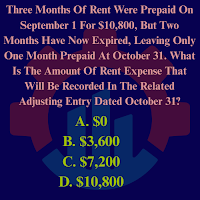
Three Months Of Rent Were Prepaid On September 1 For $10,800, But Two Months Have Now Expired, Leaving Only One Month Prepaid At October 31. What Is The Amount Of Rent Expense That Will Be Recorded In The Related Adjusting Entry Dated October 31?

Image
The correct answer of this multiple choice question (mcq) is C, as Rent Expense (RE) for two months is $7200 i.e., $3,600 + $3,600 = $7,200. Explanation: Rent (R) for 1 Month = Total Amount of R / 3 = $10,800 / 3 = $3,600 Here, we need to find out RE for 2 months from 1 st September to 31 st October, so RE for 2 months = $3,600 X 2 = $7,20

Which Of The Following Are Not Expense Accounts? (Check All That Apply.)

Image
The correct options of this multiple choice question are D and H, as Accrued Expenses or Expenses Owing are current liabilities which shows those Expenses (Exp.) which are incurred by the business but the payment is still not paid. So, the business is liable to pay for the benefits or services received. Accrued expenses are shown on liabilities & equity side on balance sheet under current liabilities heading. When the company paid the full payment, accrued expenses are closed and it will no longer to be shown on balance sheet. Dividend is not an expense for the business as it is not used for conducting or operating the daily business activities. It is paid out of the profits which the business earned during the period. It is a share of return of the investments of shareholders who invested in the business, so it is a Contra Equity Account. Once announced in Annual General Meeting (AGM), the company is liable to pay to its shareholders. It is shown in the statement of retaine...

Which Accounts Do Not Appear On The Balance Sheet? (Check All That Apply.)

Image
The correct options of this multiple choice question (mcq) are C, F, G and J as Utility Expense and Service Revenue are Income Statement Accounts which are Temporary Accounts (TA) as these are zero out at the end of the accounting period, so these having no balances and transferred to Income Summary Account . Dividend is a TA and a Contra Equity Account but not an Expense. It is deducted from retained earnings in the statement of retained earnings, so it is neither appeared on Balance Sheet ( BS ) nor on Income Statement. However, if the dividend is not paid to shareholder after the declaration, then dividend payable is shown on balance sheet on liabilities & equity side under current liabilities section. The profit sharing also does not appear on BS. It shows the portion of profits distributed among employees which is an expense for the company to pay to employees in the form of bonuses, incentives, etc., as a reward for their valuable achievements & contributions...

The Beginning Balance Of Retained Earnings Will Be Greater Than The Ending Balance If:

Image
The correct answer of this multiple choice question is B, as the amount of Dividend paid is more than the net income for the period, so the opening retained earnings is greater than ending retained earnings. Actually, Retained Earnings (RE) , which is retained in the business, includes beginning retained earnings plus / minus net income / net loss minus dividend paid. Example: From the ABC Company’s statement of retained earnings, we have the following information as shown below:                                                       ABC Company                                           Statement Of Retained Earnings                                     ...

Review Each Of The Following Statements To Determine Which Is Correct Regarding The Importance Of Assessing A Company's Risk Of Paying Debt. (Check All That Apply.)

Image
The correct options of this multiple choice question (mcq) are A, C and D, as if the company’s debt payment is $5000, for example, but its sources of revenues, either by selling goods or services, assets, etc., generate only $3000, let’s say, then the company is not able to pay its debts on specified time period and it is very for creditors or banks or financial institutions to give loan to such company. In case a company has lot of debt, e.g., from creditors $1,000,000,000, from banks $250,000,000,000,000 and from financial institutions $15,000,000,000, then the company is probably not able to repay its debts, so giving loan to such company is very risky for creditors, banks and financial institutions. If a company, which uses asset financing i.e., the company secures its Assets, such as Accounts Receivable, Inventory, property, etc., against loan to get financing i.e., get money to use for payments for running business’ operations or other uses, needs more money to pay off i...

List The Steps In Processing Transactions In The Correct Order.

Image
Understanding the correct order of processing transactions is one of the most important accounting fundamentals. Whether you are a student preparing for an exam, a business owner managing finances, or someone learning bookkeeping, knowing these steps helps you maintain accurate financial records and avoid costly mistakes. Every accounting system—from a small business using spreadsheets to a large corporation using accounting software—follows the same basic transaction processing cycle. While software automates much of the work, the underlying accounting principles remain unchanged. Step 1: Identify Business Transactions The accounting cycle begins by identifying business transactions. A business transaction is any financial event that changes the company's assets, liabilities, equity, revenue, or expenses. However, not every business activity qualifies as an accounting transaction. For example, negotiating a future contract is not recorded until an actual financial event occur...